

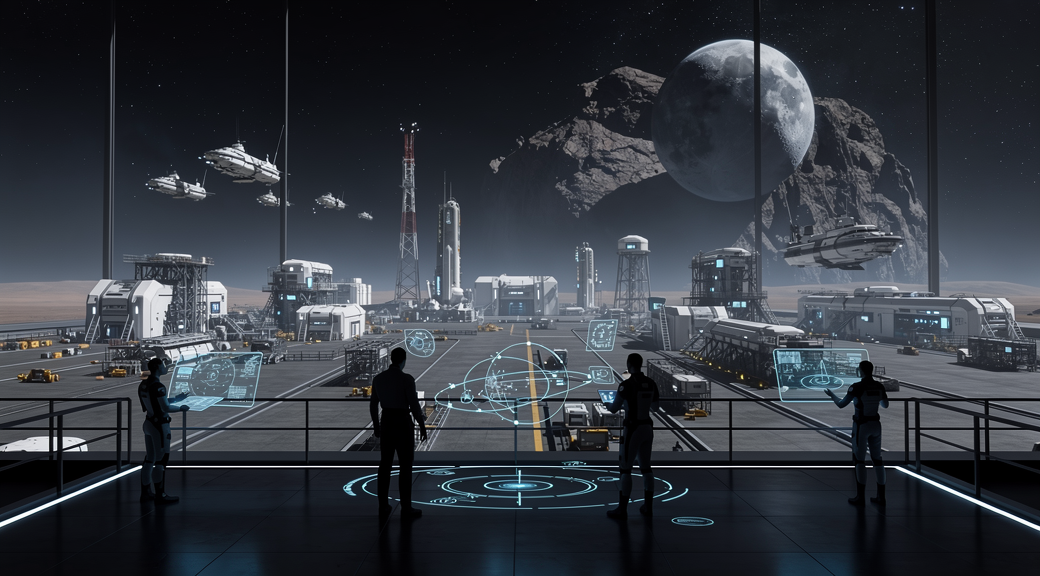
AEON was founded to solve a practical problem disguised as a philosophical one: if humanity intends to travel farther, it needs institutions that can think farther. Deep space exploration is not only about singular launches or headline discoveries. It is about maintaining capability across decades, distances, and uncertain conditions.
What AEON is built to do
The agency combines mission operations, advanced systems research, launch coordination, scientific analysis, and long-duration logistics under one command structure. That model keeps discovery tied to infrastructure. It also prevents exploratory missions from becoming isolated demonstrations that cannot scale into durable programs.
AEON treats every mission as part of a larger lattice. A probe, a habitat, a relay array, and a launch vehicle are all pieces of the same operating system.
Institutional approach
Public accountability matters to the agency’s identity. AEON publishes science reports, operational summaries, and mission briefs so that each advance can be understood in context rather than reduced to spectacle. The goal is to build legitimacy through rigor and transparency.
That discipline extends inward as well. Mission planning is intentionally conservative at the systems level so the agency can be ambitious at the exploration level.
Long-range view
AEON’s long-term work focuses on three fronts: resilient communications, autonomous science in remote environments, and the logistics needed to keep human and robotic missions moving together. The agency believes the next era of exploration belongs to organizations that can sustain presence, not just reach it once.